PFD Foodservices webform solution: A Community Cloud Case study

A problem a lot of businesses face these days is around the communication of information; how can my supply business who use this software best talk to a distributor who use that software. That was the problem MessageXchange was approached with. PFD Foodservices is a distributor of fresh foods and groceries around Australia. They communicate with hundreds of suppliers and distribute to hundreds more. PFD Foodservices, like a lot of businesses, had previously sent purchased orders, received invoices and communicated other information by fax, post or email.

So what was the problem?

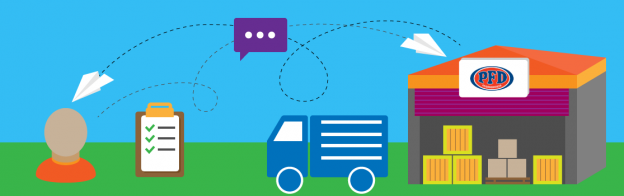
Communicating by fax, post or email is prone to data error, as it involves double-handling. It isn’t an efficient means of detailed communication. Before implementing Community Cloud, PFD Foodservices would have to create a purchase order in their system and send it to the supplier, who would then respond to the purchase order (PO) in their own way. The supplier would create an advanced shipping notice (ASN) in their system and then, generate an invoice in another program.

Why Community Cloud?

PFD Foodservices wanted standardise their communication with suppliers through Electronic Data Interchange (EDI). Community Cloud removed the hassle for suppliers, particularly small to medium suppliers. They can now oversee the whole process in one portal. No more updating this program to reflect that program so that it matches another program.

What can Community Cloud do for PFD Foodservices suppliers?

Community Cloud lets PFD Foodservices suppliers manage four key processes in the one easy-to-use area.

1. Receive purchase orders

When PFD Foodservices sends a supplier an order, they will be sent an email alerting them to request. It’s easy to then login to the portal to view and respond to the order.

2. Send a purchase order response

Once the supplier has received the purchase order, they can ‘turn it around’ and give a response. Everything is pre-filled, so all they have to do is make amendments. This removes human error and keeps data integrity; something that was not possible before when using manual forms of communication. Suppliers also have the option to export or print this information as they need.

3. Generate dispatch advice

Using the information that was in the purchase order response, suppliers can then generate a dispatch advice. With a few clicks of a button they can tell the system exactly what items were placed in which box, and create a barcode label for the package. This information can be seen by both parties and makes everything easily identifiable.

4. Generate an invoice

With another click of a button suppliers can send an invoice off to PFD Foodservices. All the information is again generated from the purchase order response, so there’s no need to re-enter the information.

What is involved in the setup?

All suppliers will need is a computer, Internet connection and a quality laser printer to fully comply with the requirements of PFD Foodservices. It’s so easy. For less than the price of a coffee a day, suppliers can send and receive unlimited messages and get help from the MessageXchange helpdesk when they need it. Suppliers can now forget about follow up or efficiency costs. They won’t have to chase invoices because they were sent to the wrong address or the email bounced back; everything is automated in the portal. Community Cloud goes beyond just a web form; it makes your business more efficient. It allows you to spend more time on things that really matter; your core business. It removes the need for lots of data entry and keeps everything in one place. Speak to us today to find out how your business can use Community Cloud to communicate with PFD Foodservices and other distributors.
EDI: The Secret for Efficiency, Productivity and Success

Electronic commerce (e-commerce) has existed for over 50 years, enabling commercial transactions between and amongst organisations and individuals. In the early 1980’s, EDI (Electronic Data Interchange) emerged as a next stage of e-commerce development, allowing companies to exchange business documents (e.g. PO, invoices and ship notices) in a standard electronic format. If we analyse the busy world of retail, businesses today need to be aware of the ongoing industry challenges. Factors such as the emergence of new data-capturing technologies; the rise of mobile payments and increase of online businesses; the need to connect with users in multiple channels and customers’ need for speed; and the continuous challenges on supply chain management, are all threatening businesses performance and success. For this reason, through the implementation of EDI solutions, retailers will be in the position to take advantage of the following benefits: • Reduced Costs – eliminating or reducing administrative and personnel costs • Improved Data Quality and Accuracy – eliminating errors resulting from manual data input • Increased Business Efficiency – allowing businesses to concentrate on higher-value tasks • Increased Processing Speed – allowing businesses to communicate data more efficiently and accurately. Large volumes of commercial data can now be transferred from one business to another in matter of minutes, enabling faster response and greater customer satisfaction • Enriched Visibility – facilitating faster decision-making processes and improved responsiveness to customers and market demands • Shortened lead times for product enhancements and new product delivery – improving and building stronger relationships with business partners • Improved Customer Service – addressing customers’ questions and concerns more effectively since information is available on a “real-time” basis • Enhanced Logistics Management and Increased Productivity – allowing companies to manage and control production, purchasing and delivering requirements more efficiently From these benefits, we can observe that the use of EDI shapes the success and efficiency of a business supply chain management and business operations. MessageXchange is a cloud B2B Integration and Collaboration service that facilitates connection, mapping and message exchange across all industry standard formats and protocols. MessageXchange is capable of providing business solutions, for companies who are seeking to automate, map, log, and track complex or long messages of all data sources. Speak to MessageXchange today to see how we could tailor a solution for your business.

From farm to table: spice up the taste for supply chain management

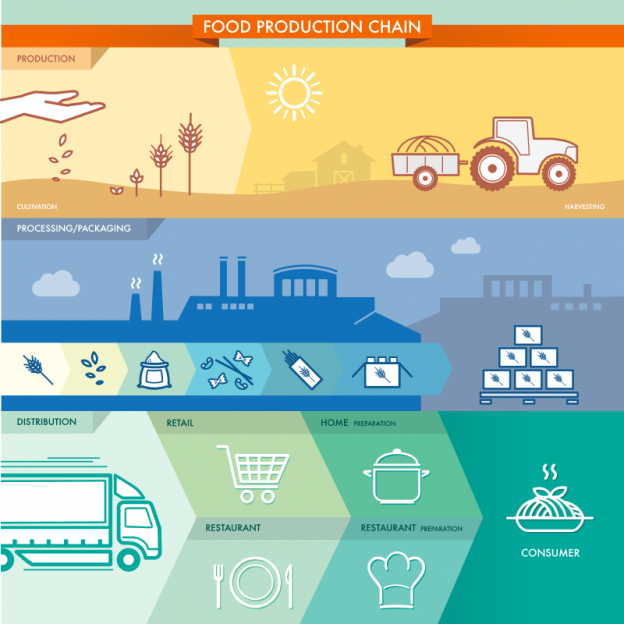
Efficient supply chain management has become a fundamental seasoning for business success and performance. Diners are increasingly influenced by tendencies. The proliferation of online information is driving and shaping consumer habits in unprecedented ways and with this, the awakening of their desire to know the whole story about the food served at their tables. Behind the scenes, this trend has increased the complexity in logistics and supply chain maneuvers, challenging businesses within the Foodservice Industry. It is not surprising that businesses are becoming more focused on improving their supply chain operations; an area that has been overlooked for far too long. Supply chain is the network of organisations, linked together from the upstream raw commodities suppliers to the downstream of final products or services, and the end consumer. For this reason, supply chain can be seen as an equation: the sum of all existing relationships that are involved in building a business ecosystem. A successful supply chain will produce value in meeting the customers’ expectations. Therefore, engaging and connecting every stage of these links, presents its own opportunity to develop a stronger supply chain management and enhance business operations. However, as supply chain management is diffusing within the corporate world, in order to remain competitive, small businesses might be wondering how can they achieve an efficient supply chain management. Fortunately, as technology evolved over the past decade, businesses today have the privilege of engaging and connecting its business ecosystem at its desire pace, and most importantly, doing so at a cost-effective manner. MessageXchange is a cloud B2B Integration and Collaboration service. It provides a solution for businesses seeking to connect and improve its supply chain efficiency, attaining an end-to-end visibility and traceability of its processes and activities. Business will be able to obtain:
  • Better investment. Improve efficiency with no CAPEX
  • Better integration. Automate, map, log and track complex or long running supply chain messages of all data sources (EDI, GPS, EFID and XML)
  • Better visibility. Achieve additional insights and visibility via customized reports
The efficiency of supply chain can vastly determine the success and performance of a business. A successful supply chain will assist companies in improving their business operations and meeting its customer’s expectations. Customer satisfaction has powerful effects on the business bottom-line profitability. Speak to MessageXchange today or Join us at the GS1 Food service Industry Seminars, to see how we could tailor a solution for your business.